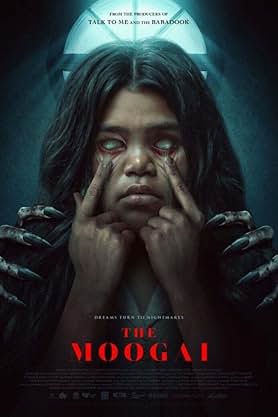

“The Moogai” (2024) begins in 1970 when the Australian government kidnapped and trafficked Aboriginal, i.e. indigenous, children, who were called the Stolen Generations or Children. Fast forward to 2024: Sarah Bishop (Shari Sebbens), a successful lawyer, wife and mother, is expecting her second child, Jacob (Piran Stone), but nearly dies in childbirth. Her life gets upended when she is beginning to see things and believes that someone is trying to take her children. Will she finally stop dismissing the warnings from her birth mother, Ruth (Tessa Rose), and take her advice? If you are looking for cheap thrills and for everything to be spelled out, then move on, but if you are looking for a horror film about healing generational trauma in the vein of “Frewaka” (2024), then writer and director Jon Bell’s expansion of his 2020 short film and feature debut is perfect for you.
Sebbens as Sarah is terrific at filling in the blanks with her expressive acting style, which conveys a lot that is unsaid and may not be obvious to the average viewer. Sarah is part of a generation that believes her professional success and complete assimilation to mainstream society will insulate her from any problems, but she begins to get her wakeup call. Because of the body that she inhabits, the slightest misstep or misunderstanding will erase all the privilege she has been able to glean. As a woman, her body becomes a public space, and she loses autonomy. As a person of color (Aborigines are referred to as black, but they are not a part of the African diaspora though their skin color gets them similar treatment), her credibility weighs less than others with more privilege. She cannot make mistakes, and by being a person who cannot sleep, once took the doctor prescribed drugs and accepts drinks from her work bestie, she risks losing her children to the state. Nothing can stop a systemic machine from criminalizing her and her family into its gears even though the earlier government policy is gone.
The titular monster is undoubtably supernatural and separate from the state forces that encroach on Sarah and her family. What does the Moogai symbolize? In the Bundjalung language, which originates in an Australian region, it has three meanings: spirit/entity, the Bogey Man and stealer of children. There are many ways to steal children or commit genocide, and in many ways, Sarah is stolen, and “The Moogai” is a struggle for her soul. The monster is internalized racism like “It Lives Inside” (2023), and if Sarah does not exorcise it, her children will get stolen too because she will keep them separated from their culture.
To be fair, “The Moogai” keeps vague regarding how Ruth lost Sarah though the story implies that like Sarah, Ruth was a good mother who was never given the benefit of the doubt. Mental health issues are implied so one aspect of the horror is Sarah’s fear that she will inherit her mother’s madness, but the practical stakes of that fear are so high that when the movie ends, combined with the state’s over-policing of women and people of color, it does not feel as if there will be an escape even if the supernatural enemy is off the board. Of course, if Sarah is armed with her heritage, she will not truly lose them or herself through self-condemnation.
While it makes sense that Sarah could resent her mom for losing her, the way that she exhibits her contempt is complete rejection of her culture. It also is not an accident that when the supernatural starts to disrupt her life, she perceives her daughter, Chloe (Jahdeana Mary), as a threat and a monster then equates her to the Moogai. She dismisses her mother as crazy and is eager to erase any of her remedies because the cure highlights her difference from her adopted society whereas she wants to fit in. When Ruth knocks, Sarah reacts terrified as if it is the cops at her door. Sarah literally fears Aborigine girls and women’s bodies. Ironically only the state’s rejection of Sarah severs her allegiance to the state, which brings her closer to her roots.
It is too bad that Bell did not elaborate on Chloe’s relationship with her Nan (grandma’s nickname) to illustrate her instinctual connection even though Nan was not always an instrumental part of her life. Simon Njoo’s editing also implies that before Sarah’s near-death experience, the sight of her daughter triggered Sarah’s labor. Chloe just seems disappointed as if it is nothing new, and the backstory seems as if the problem originated before “The Moogai” started. Chloe probably is not lying about her mom hurting her though others derive the wrong meaning from her words. If these scenes ended up on the cutting room floor, it was a mistake, and more could have been sacrificed instead of the potential of that unrealized storyline.
While Sarah’s adopted mom (Tara Morice) is misguided when she opines on how Sarah should react to Ruth’s suggestions considering the threat, she is not the enemy. It would have been nice to either have an excuse why she and her husband (Nicholas Cassim) did not intervene more during “The Moogai” or not included them at all. “Fancy Dance” (2024) did a better job of illustrating the tension between love for family from different cultural backgrounds and allegiance to the state.
It is not the only connective tissue that is missing in “The Moogai.” The last scene featuring Sarah’s husband, Fergus (Meyne Wyatt), is a tad unclear though the implication is crystal. Also Fergus’ brother, Ray Boy (Clarence Ryan), should have been cut altogether. He is supposed to be comedic relief, but the character functions as if he belongs in a different movie.
The oneiric sequences in “The Moogai” apparently have deeper cultural significance than any viewer will understand if they did not come to the movie with some prior knowledge of “The Dreaming” or “Dreamtime” Even after reading about it, I don’t fully understand it, but Sarah’s death gave her an unwanted connection to the past/her ancestors, which alerted her to the danger of losing her children. Lost children have white eyes, which is unsettling, but could also describe a restrictive way of viewing the world in a way that does not protect them, which is how Sarah behaves. Sarah does not want to see. “You can see things these fucking troglodytes cannot even imagine.” It explains the end of the movie, which will make sense regardless, but not as much without prior knowledge of this term.
It is not fair, but Bell has a little too much confidence in his audience’s ability to treat the mythology of his culture with the same respect and curiosity as Nordic or Celtic folklore. As a film critic, it is frustrating to not easily be able to access information about certain cultures whether African gods or Aboriginal spiritual practices when researching symbols in a film while also knowing that lack of availability may be necessary gatekeeping to protect the actual practitioners from further exploitation. For instance, snakes could symbolize ancestral protectors. “The Moogai” is probably better than most critics believe because we do not understand everything that we are seeing. As a first-time feature filmmaker, Bell’s first time at bat is a success, and people should stay glued to see how his work will evolve.
Streaming on AppleTV, Google Play, Vimeo