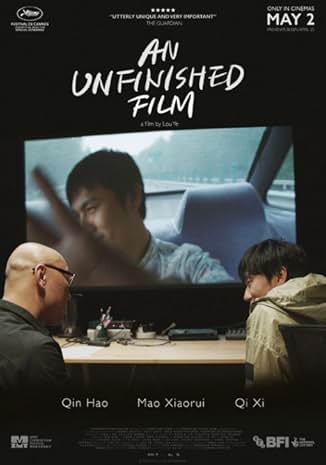

“An Unfinished Film” (2024) is set near Wuhan, China and starts on July 15, 2019. A film production team has gathered to see if a ten-year-old computer hard drive is functional enough to retrieve the data, footage from an incomplete film. The retrieval sets off a chain of events starting with the resumption of shooting of the decade old film just before Chinese New Year, but the Covid-19 pandemic interrupts the production once more. With the movie no longer a priority, the team, particularly Jiang Cheng (Hao Qin), the star of the ten-year-old film, wonders how to spend the time in quarantine, and if they will ever return to their regular lives.
When “An Unfinished Film” begins, it feels as if Director Xiaorui (Mao Xiaorui) is the protagonist because he is the one that everyone orbits, including Jiang, a man with a busy schedule who decides to fit in the movie between the small gaps of his packed schedule, which include spending time with his wife, Sang Qi (Qi Xi) and their baby girl, Paopao (Youyou). The second act is more of an ensemble affair with long, meandering cuts akin to Robert Altman’s “The Player” (1992) as the camera treats the subjects like a relay race passing the baton to each other so everyone takes turns getting the camera’s attention. Production is business as usual until Tang (Zhang Songwen) brings unwelcome news from the world outside, but like all Cassandra figures, is ignored. The next act is the panic as people are in a rush to leave already too late to escape quarantine and return to their families. The subsequent section finally focuses on Jiang as the personification of the remaining stages of grief as his stardom proves ineffective in the face of forces larger than himself. The rest of the movie is mostly solitary, but occasionally technology disrupts the state-imposed isolation, and people find a way to congregate and stay safe. Then the film increasingly relies on other footage taken at the time of the pandemic and not done in concert with the creation of this film. The film then transitions to collective, outside grief reminiscent of “Songs of Slow Burning Earth” (2024) to the resumption of normal life and still no finished film.
For people who did not experience the pandemic or do not mind relieving the pandemic, “An Unfinished Film” is the definitive film of that era, which is why viewers who do not normally watch films that they live through should probably avoid this movie. A lot of films boast of being genre defying, but are easily classifiable, and many more claim to make it impossible to separate fact from fiction. This masterpiece is one of the few films that delivers on those promises, but not to entertain or as an attempt to reinvent the horror film genre. It is an autofiction story that brings the energy of the “Hey, Let’s Put On a Show” trope that soon gives way to dread, love, celebration and oppressiveness using screen casting (now known as screen life), found footage, social media and archival news footage elements.
While “The Seed of the Sacred Fig” (2024) is overall more entertaining, “An Unfinished Film” solves the visual problem of “anti-film,” how to mesh the vertical phone screen with the horizontal screen for all the other forms of media, including the big, silver and desktop screen. Director and cowriter Lou Ye solves it in such an obvious way that other directors must be smacking themselves in the head. Use split screens, which is a technique often used to depict two people on the phone or just people in different locations at the same time. This technique goes back as far as 1913. Codirectors Lois Weber and Phillips Smalley invented it in a silent short film called “Suspense,” which the author has not seen. To distinguish between the reality of the person in the film who is talking to a person on the phone, the person in the film remains in a horizontal screen, but the left side contains the vertical screen. Audio-wise, it still needs work because hearing people talking two times simultaneously does not have a stereo effect but is grating and makes it difficult to focus as opposed to instinctually running away from the irritating sound. Like its Iranian counterpart, Ye’s film preserves videos and history before it can be scrubbed from the internet and censored.
Long time fans of Ye’s work will have an advantage over newcomers. No new moviegoer would automatically know that “An Unfinished Film” uses outtakes and documentary footage from his earlier films “Souzhou River” (2000), “Spring Fever” (2009), “Mystery” (2012) and “The Shadow Play” (2018). They would believe that these excerpts are scenes from one unified movie, the titular unfinished film. If I had more time, I would watch those films then rewatch “An Unfinished Film” and see how the clips had additional meaning indiscernible to this narrative for anyone who is watching this film in a vacuum. To be clear, this film is not a sequel to those other three films. The film was originally intended to tell a story about how Chinese people collectively transformed over the years instead of as a snapshot of a particular critical historical turning point that now belongs in the ranks of BC and AD.
Even if you did experience the pandemic first-hand, “An Unfinished Film” still has value because if you are not from China, it is interesting to see how it was handled and the reactions to restrictions contrast with your own region. No wonder almost no one dies or gets very ill in the movie. Everyone is so obedient or soon become so after they are commanded to do something for their public health. The nightmare was watching how people wanted to go home once they knew that they were exposed to infected people so even though it is difficult to watch law enforcement crack down on everyone, and it was easy to relate to the film crew’s outage at suddenly losing their freedom of movement, with the benefit of hindsight, the government saved people from their instinctual stupid, but human instinct to seek safety with their loved ones. No wonder vampire movies always show the fledgling vampire seeking their family out. On the other hand, it was appalling to see how quickly people complied and did not stick up for a member of the crew from Wuhan whom the hotel discriminates against and kicks out before lockdown.
If “An Unfinished Film” deserves criticism, it is the idea that lockdown was lifted because the pandemic ended. People are still dying soon after getting infected with Covid-19 even as coroners claim that it is correlation, not causation, perhaps to decrease the public numbers and lessen the strain on public funds obligated to go to the infected and affected. It is a small quibble since it is a universal fiction that everyone engages in to pretend that we are safe and function in society.