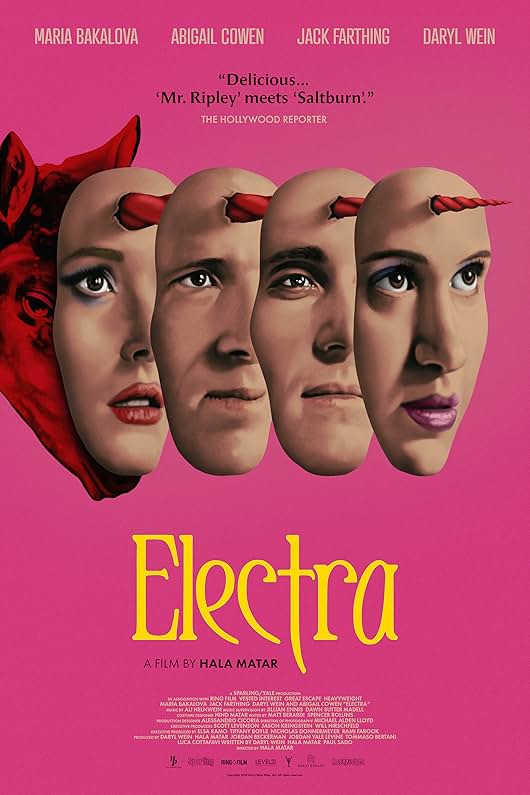

“Electra” (2024) is about two couples, an American journalist and his photographer girlfriend, Dylan Andrews (Daryl Wein, who is also a cowriter), and Lucy (Abigail Cowen), who are doing a profile for Wired magazine on Milo (Jack Farthing), a notorious British rock star. They charm each other so much that their interview spills over into an al fresco dinner in Rome. Francesca (Maria Bakalova), Milo’s Bulgarian/Italian performance artist/girlfriend, joins them. The couples hit it off so well that Milo invites the American pair to Francesca’s sixteenth century palazzo on a country estate where their secrets emerge, and their facades begin to fall. Who is Electra?
Dylan is not particularly interesting except he does not seem like the best journalist. He does not know basic facts about his subject and has a hidden agenda that is a mystery even to him. Soon after the first act begins, it becomes obvious how “Electra” will end, but moviegoers are stuck for the entire runtime if they want to see how it plays out. Milo and Francesca notice how awkward he is with his girlfriend, and Dylan seems to disassociate at random intervals. Wren feels like a brand name Josh O’Connor. It is hard to buy that Milo would humor him. Cheers to Wein for generating work for himself, but out of the four characters in the movie, Dylan is the least interesting.
Milo is more interesting, but he is more believable as a rockstar because of his surroundings, accommodations, wardrobe and women, but there is nothing innate about his persona that screams irresistible, magnetic charisma. Farthing plays Milo more like Jared Leto than Sam Reid or Stuart Townsend, which works if “Electra” was aiming for overhyped performer who should be exiled from the spotlight as opposed to irresistible rocker who could reemerge given the right amount of attention. When he talks about his father, it feels like a missed opportunity to parallel troubled family dynamics and goes nowhere. There was a strong theme with Milo and his attempts to maintain a connection with his son. It was the most interesting aspect of his life. More of Milo’s desperation needed to be evoked because he kept ignoring the red flags out of survival. A few more scenes with him on the phone conducting business could have helped. It worked for “The Ballad of Wallis Island” (2025).
Lucy feels familiar though she is underwritten. Initially she presents as confident and daring, but in private moments with Dylan, she seems hesitant, more reserved and in need of anyone’s validation and attention besides Dylan. She clearly prefers hanging out with the couple, especially Francesca, because she harbors a deep desire to become an actor, and Francesca’s playful nature encourages experimentation in playing characters. There is also a mild sapphic attraction that simmers throughout the story. In demeanor and looks, Cowen plays Lucy like Gillian Jacobs in the television series “Community” if Britta was cooler and more avant garde. Cowen is solid in all her scenes, and when she shares the screen with Wein, she is doing all the heavy lifting.
The real star is Maria Bakalova, which is not a surprise if you remember her performance as Ivana Trump in “The Apprentice” (2024). She seems to get her character on a bone deep level and simultaneously plays conflicting emotions in every scene thus crafting a complex portrait of a woman who could easily be rendered a caricature or unsympathetic as the affluent, outlandish woman who plays broad theatrical characters, but is also a real woman just living her life and playing it straight. In the scenes with Milo and Francesca, Bakalova plays her character with more vulnerability who for all her bravado is shy and does not want to be perceived in the harsh glare of fame. She is like an adult who never lost the ability to play and found a way to evolve that pastime into maturity but also can sense when she is being used. There is still a naïve limitation in her ability to translate lies into a proportionate level of alarm.
If “Electra” is worth watching, it is thanks to first time feature Bahraini director, cowriter and chief costume designer Hala Matar, cinematographer Michael Alden Lloyd and whoever found the palazzo, which is practically another character in the film. Every detail looks colorful and tells a separate story. “Electra” is divided into five chapters with a few subsegments devoted to Francesca and cute little jokes like a postcard from an expensive hotel that gets details crossed out to reveal the true place where one of the couples is staying and the actual cost per night. The second most relatable subsection is titled “Midnight Mozzarella with Francesca.” Otherwise, the structure did not enhance the story and only had the effect of wondering how many more until the movie ended. Ninety-minute movies can feel like an eternity in the wrong hands, and the narrative is weak thanks to the aforementioned cowriters and cowriter Paul Sado.
It is hard to grab a New Yorker’s attention when someone is doing the most. If a New Yorker paid attention to every needy showboat, nothing would get done so it takes something more than just flash and theatricality to get us to stop ignoring you. New Yorkers spend their lives tuning out noise. “Electra” starts at a ten so without any ebbs and flows, the average baseline feels lower as if it is a one whereas if a movie starts at a lower register, then gradually ramps up, it is easier to hold viewers attention. Eventually the shenanigans, which include a LSD trip, are indistinguishable from the couples’ quotidian social activities thus rendering it boring. It feels impossible to feel invested in anyone’s agenda except for Francesca, who seems like a ringmaster who reported to the wrong circus.
Though the comparison does not fully convey the film’s vibe, “Electra” feels like a mashup of “Saltburn” (2023) meets “The Comfort of Strangers” (1990) sadly without the homoeroticism, and it tries to end on an upbeat note, which feels like a math equation that does not add up in terms of tone. If as much effort was put into the story as the film’s look, it may be worth watching. The title references a character named after the Sophocles tragedy about siblings killing their mother to avenge their father, and while the movie is about revenge, it also feels like an afterthought because ending the movie was going to be almost impossible considering what came before.
Only watch “Electra” if you are a fan of the cast or prefer visual style and uneven character studies over a cohesive narrative. Otherwise prepare to be disappointed that this heist movie will just steal your time and leave you with nothing except eighty-five minutes that you will never get back.