
“You’ve made a career out of bodies.”-Terry
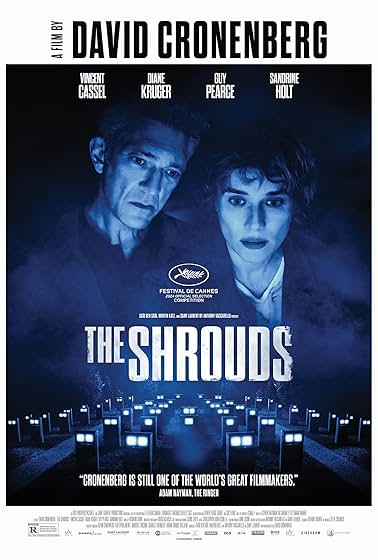
“The Shrouds” (2024) follows Toronto-based Karsh Relikh (Vincent Kassel, who is styled to look exactly like Canadian writer and director David Cronenberg), former producer of industrial videos turned death care innovator hidden in the cyber shadows. After his wife, Becca Gelernt Relikh (Diane Kruger), died four years ago, he decided to create a company called GraveTech that invented the titular invention, which is essentially a camera shaped to envelop the deceased’s body in the grave so the surviving relative can see them through an app. When several graves are vandalized, including Becca’s, and the loved ones, including Karsh, can no longer access the feed to see their loved ones, Karsh investigates who is responsible and what are the nodules on her bones. After the death of a loved one, can people move on, or will they find new excuses to linger and perseverate on the past? Only completist Cronenberg fans should watch his latest film, and even they should get a lot of sleep and drink coffee before watching or they may discover that this film is a soporific.
Karsh’s obsession with his wife’s body parallels his exposition about the Jewish burial rite. “The body must slowly disintegrate so that the soul which is obsessed with that body, which loves that body, which hovers over that body and is reluctant to leave it, which has seen the world only through the eyes of that body has time to gradually let go of that body, say goodbye to it and then ascend to heaven….She said she wanted to be beside me in death.” Karsh is no disembodied spirit, and his unspoken frustration is not knowing parts of her. He will never truly let go. Though he describes his ability to see this decaying process as more substantial than the way that he knew her during their marital life. Because he knows every detail of her body, he notices a postmortem change, bone growths, and his search for an explanation becomes entangled with identifying the vandalizer. Cronenberg often shoots Cassel as a futuristic Jean-Paul Marat in a tub, but instead of holding paper, Karsh holds an iPad.
Becca’s sister, Terry Gelernt (also Kruger), explains the growths as part of her theory of a doctor conspiracy to try experimental treatments on Becca. Maury (Guy Pearce), who was married to Terry and shows frustration that he does not have a monopoly on GraveTech IT, suggests ecoterrorists then later points to the Chinese company, Shining Cloth Technologies, which the Chinese government has a controlling interest in, that worked on GraveTech software. Maury also invented Hunny (also Kruger), an AI personal assistant who is more than a disembodied voice and appears as an avatar who resembles Becca. Soo-Min (Sandrine Holt), an affluent soon to be widow of Karoly Szabo (Vieslav Krystyan), head of an electric car manufacturer, Citadel Technologies, reveals that the Hungarian government is concerned that the Russians could hack into the shrouds’ technology and use it for surveillance. Gray Foner (Elizabeth Saunders) who handles GraveTech security, believes that the vandalizer is part of a political conspiracy from a group against “techno atheist infidels.” Cronenberg uses technology like elaborate bells and whistles to distract the viewer from following the thread of Karsh’s flashbacks as the conspiracy theories rack up and another mystery bubbles to the surface, a missing doctor, Dr. Jerry Eckler (Steve Switzman), the chief oncologist who treated Becca.
Do you remember the “Save the Tatas” breast cancer campaign? It was amusing, but a deeply reductive slogan that reduced women to their body parts. If you do not like that phrase, Cronenberg’s latest film is not for you. Think “Crash” (1996) except substitute a sexual fetish for car accident injuries with cancer treatment mixed with marriage and affairs resulting in multiple love triangles. It started as a Netflix series, but the platform stopped financing after two episodes, so Cronenberg decided to convert it to a film format.
In 2017, Carolyn Zeifman, the director’s wife of forty-three years and mother to directors Brandon (“Possessor” and “Infinity Pool”) and Caitlin Cronenberg (“Humane”), died after forty-three years of marriage. She too was a filmmaker and collaborated with her husband since “Rabid” (1977). No one knows what life is like in a marriage, and the experience is different for the people in it. There is no wrong way to grieve, but it does offer a window into a person’s inner workings. It would be interesting to know what Zeifman would think of her death inspiring and resulting in “The Shrouds.” Maybe she would love it, which is why she became a Cronenberg, and I just frequently visit his world.
If my husband only conveyed his obsessive grief over losing my body and its parts without mourning my mind, soul and the way that I navigated in the world, I’d feel as if I wasted my life and time on that person, which is how I feel about “The Shrouds.” Karsh says, “I did love that body.” No. Love would mean taking his wife to the hospital and being with her while she receives treatments. A marriage is six times more likely to end if the wife gets sick with cancer. To the people who praise this film as revolutionary for showing the scar after a mastectomy, Google is free. Just because you have not seen it in a movie, does not mean that it does not exist, and a quick search would have disabused you of that notion. Hopefully Karsh is not as much of an onscreen surrogate for Cronenberg as he appears to be. While this movie is post-Cronenberg’s graphic body horror phase, you can take the body out of the horror, you cannot take the horror out of the body.
Karsh is an opportunistic psychopath and only thinks of people as bodies that benefit him: for sex or money. He said, “I lived in Becca’s body. It is the only place I really lived. Her body was the world, the meaning and the purpose of the world.” Karsh describes his intentions towards Szabo, “I want his rotting body in our cemetery.” When Cronenberg shows Karsh’s memories in bed before and after Becca’s treatments, she is breathy and naked ready to go even after a surprise surgery carving huge bits of her out. Let me ask you. If you just had your arm removed, would you be able to get home from the hospital, take your clothes off without help and be ready to get down with your husband? Probably not, but good for you if you can. Karsh is an unreliable narrator, and he meets the Cronenberg rule: underneath civilized, technologically advanced people is an out of control, sex-obsessed perv.
S
P
O
I
L
E
R
S
Karsh’s conspiracy, which he acted on, is that Becca and Jerry had an affair, which is why Jerry kept her body parts. He projects his obsession with Becca’s body on to Jerry. Before Jerry could share his scientific findings and Becca’s body parts at a convention in Iceland, Karsh shot and killed him and used Maury’s plotting to cover up his crime. By burying Jerry’s body next to Becca, Karsh punishes his imagined Becca’s infidelity and denies her last wish to be buried next to Karsh. In a metaphorical sense, by getting cancer, Becca is betraying Karsh and spending more time with the doctor, but Karsh makes this irrational feeling literal.
One way to gain control and rein in the sprawling helplessness of grief is to imagine a conspiracy and lash out in the real world against a concrete subject. Terry accuses Maury of “inventing stuff to be resentful about,” but he is not the only one. Dr. Rory Zhao (Jeff Yung), the only person who does not have a knee jerk reaction to jump to conspiracy theories, is not worried about his colleague’s disappearance, and his conclusion about the electronic bone nodes can be equated with most of the conspiracies: “They’re not real.” Occam’s Razor.
If “The Shrouds” has value as a movie, it is showing the limitations of coping with grief and the ripple effect on people’s lives. Unfortunately, the road to this authentic, relatable lesson is so enervating that you may not stay awake long enough to appreciate it. Also the subtle Tesla ad placements did not age well, and the movie only just got released.
Side note: My favorite character in “The Shrouds” is blind date Myrna Shovlin (Jennifer Dale) who clearly ran as far from Karsh as possible, thought that there is not enough money in the world and did not ignore any red flags even though he was handsome in an off-kilter way. I can’t cosign a lot of what Myrna said, but she gets the award for honorary Black person in a film with no Black people for never appearing again once she senses danger!