
Disclaimer: This screener came with five viewings. I had a lot of technical problems with the screener from abrupt disruptions in playback to the captions being out of sync with the onscreen action. Each termination counted as a viewing. While I saw the whole movie, I never saw the movie in one complete uninterrupted, problem free sitting, and it is possible that I missed a lot. Believe it or not, there are critics who come late to movies, watch a fraction of the movie, or leave once they are bored, so I want to clarify that was not what happened in this case.
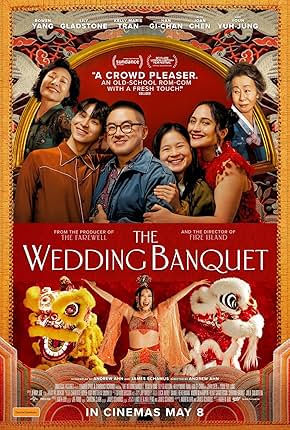
“The Wedding Banquet” (2025) is a remake of Ang Lee’s 1933 film. Angela (Kelly Marie Tran) has been friends with Chris (Bowen Yang) since college, and now their respective partners, Lee (Lily Gladstone) and Min (Han Gi-Chan) are ready to take the next step in their relationship. Lee wants a baby and mortgaged her family home to have invitro fertilization while Min’s grandmother, Ja-Young (Yuh-jung Youn), is pulling the purse strings tight to bring Min back home to South Korea. (Spoiler alert: at the time of theatrical release, she could just wait, and he would get sent back without her lifting a finger, green card or not). Min proposes to Chris, but Chris says no for reasons. Naturally Min offers to pay for fertility treatment if Angela would marry him, but Min’s grandmother decides to visit to ensure that their relationship is real. How about everyone remake a bad movie for a change so there is room for error.
The cast of “The Wedding Banquet” is its best asset. An Oscar award winner (Youn) and nominee (Gladstone) are the best part of the movie, but they are supporting characters with less screentime than they deserve. Joan Chen is a legend, and it such a treat to see her again after “Didi” (2024), but can she be in more please. Kelly Marie Tran was one of the best actors to emerge from the latest “Star Wars” trilogy, which made the toxic fanbase attack extra unfair. Bowen Yang is a comedic standout in “Saturday Night Live,” and my favorite Yang role is as God in “Dicks: The Musical” (2023), but he is probably the weakest link in the cast, and he is supposed to be carrying a good percentage of the movie. With weak writing, a stronger actor needed to be in his role to fill in the blanks that director and cowriter Andrew Ahn and cowriter James Schamus, who was a part of the three-person writing team in the original film.
It is as if Ahn and Schamus looked at the original and put it through a filter to discard anything resembling an authentic experience. Lee, a scientist, possibly an invertebrate biologist, and Angela, the executive director of Hometown Pride Social Services, worry about money in a vague way while totally not living as if it is a concern. I kept thinking that in addition to getting the money for the IVF treatment, they should get enough to pay off the second mortgage since they all live there. It is this beautiful fantasy of adult life where you see your friends daily and live together in harmony. Min is the nicest Chaebol ever. Chris is a birding guide, which is linked in a funny way during the wedding ceremony. In the original, the protagonist actually owned real estate and could afford to travel, but he seemed poorer than this crew. It is nice to escape through movies, but it is so removed from reality in contrast to the original that it was painful.
“The Wedding Banquet” has a pacing problem. Because the story is trying to keep both couples together as much as possible, it means that neither pair gets enough screentime to complete a fight or a poignant moment without interruption or witnesses. It makes it harder to root for them. The first film established the couple’s dynamic and the landlord tenant relationship between the future married couple as more personal from the outset. Here it gets told, not shown. After seeing these partners, it is hard to believe that they got this far in the relationship.
Also this movie suffers the same problem as “On Swift Horses” (2024). Both movies do not realize that they have created characters that are unlikeable. The real problem seems to be that Angela and Chris are soulmates who do not seem to like their partners as much as their partners like them, but that issue is the movie’s blind spot. It is more realistic for me to sprout wings and fly than to believe that Angela and Chris would have sex together after they got drunk one night other than an epic moment of self-sabotage to communicate in the most toxic way possible that Angela does not want a baby, and Chris does not want to get married. In the original, the groundwork was laid out in the first scene with the protagonist and his future bride—there is an undeniable attraction. In this film, there are a few discarded lines that Angela and Chris hooked up once in college, but nope, it is not enough. I need Yang to do one of those actor videos that appear before a movie stating that he has had sexual relations with a woman, and even then, there is not enough suspension of disbelief in the world to buy it. They cheat so early in “The Wedding Banquet,” and they never tell their partners that it makes them awful, but it is not the worst part and kind of forgettable.
At the time of writing this review, marriage equality is still legal in the US; yet Chris does not want to marry Min, who is adorable, rich and handsome. Dealbreaker. Min, dump him. Chris kept saying that he did not want to be the reason that Min lost his money, but Min did not care. He outed himself as a bit of a gold digger. At the eleventh hour, his cousin, Kendall (Bobo Le), reveals the reason, which is supposed to prove that he is a good person, but it is too little too late.
People should really rewatch the original. It is really an immigrant story about being homesick and the anticipated grief and guilt of losing a loved one. Here, the death of a distant relative is hoped for because then everyone can be free. This iteration of “The Wedding Banquet” totally did not get the beating heart of the original. The wedding ceremony in both films is played for laughs, but in the original, it gradually expands until it is almost as if everyone found a way to transport and squeeze Taiwan into the best Chinese restaurant dining hall in New York. Here it felt as if Korean culture was being ridiculed, which could be fine because Ahn is Korean, but it had the whiff of a child of immigrants who is still vaguely embarrassed and has not fully appreciated his culture. Also the American partner in the same sex couple loved his partner so much that he immersed himself in Chinese culture. While Lee clearly loves Angela, she does not seem actively engaged in that part of her life, which may be unnecessary if Angela does not care, but it is interesting how culture takes such a back seat that it almost is nonexistent. Grandma makes a whole meal, and no one eats it. Automatic reason to hate characters. So maybe it is a small thing, but there is NO FUCKING WEDDING BANQUET! The benefits of naming a movie after a classic is cynically undeniable, there is a built in audience, but just make another movie. There would be less pressure.
There are plenty of less significant differences. Instead of being set in New York, it takes place in Seattle. It breaks the TV series “Heroes” rule (“one of us, one of them”), and people of color dominate the film. Most of the original cast was Chinese with one white man, and it was a love triangle of convenience between a Chinese Shanghai woman and a Taiwanese man, who was really a partner to said white man. Here everyone is Asian or indigenous, but Korean culture is centralized. Everyone is gay if they are not older than the main cast. By decentering the heteronormative and majority white world of Seattle and centralizing the characters, these changes made it seem possible that this film would do something bold, but nope. If you have not watched a lot of films or just like the cast, then see it, but afterwards, the original is required viewing so you can do better. It is like eating at Domino’s when the local pizzeria is superior. It is like going to Olive Garden instead of the North End or someone’s home.