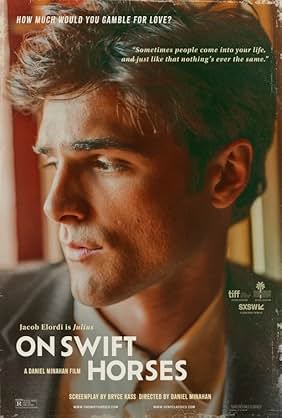

“On Swift Horses” (2025) adapts a book that should have been left on the shelf. It is as if someone watched “Carol” (2015) then wanted to make it boring. Even with Jacob Elordi taking off his shirt whenever the story flounders, and everyone being sexually attracted to each other all time, the whole movie is an inert and contrived affair that lacks heat. During the Korean War, Muriel (Daisy Edgar-Jones) and Lee (Will Poulter) are at an impasse about their future until Lee’s brother, Julius (Elordi), arrives and forms an instant connection. As they move forward, they discover themselves and what they really want. It would have been a better movie if there was no dialogue, and Elordi just stood around half naked making out with people.
Muriel and Julius are supposed to be kindred spirits running along parallel tracks, but they act more like people about to have an affair, and Lee may have a cuck, incest fetish. Muriel passes as a respectable wife and waitress, but in her off-hours, she runs around town dabbling in forbidden things like gambling on horses or breaking the law by visiting certain establishment. Julius is supposed to be the bad boy, and Lee discusses his brother’s exploits as if they are impressive, but Julius seems a bit slow and is constantly walking into traps that a less well-traveled man would see coming a mile away. Having same sex desires is equated with being a criminal, but there is a difference between being criminalized because of your difference (see any Pedro Almodóvar film) and being a criminal and associating queerness with negative elements. It felt like the internalized homophobia is winning or a straight person at the beginning of their journey to accept others, but they had not gotten fully deprogrammed. Without knowing more about Shannon Pufahl or reading her 2019 novel, the mystery will remain unsolved. There is so much potential to tell a story about two queer and/or gay people of different genders finding common ground in their unspoken double lives, but it also erases the history of that time and those kinds of relationships.
Take out that theme and “On Swift Horses” would still have plenty of problems. People don’t talk like that, and when someone is younger, it sounds cooler, but an older audience will just think, “What is this shit?” Lee describes his brother as having “passions of his own.” No, the period correct phrase would be “light in the loafers.” Muriel and a distant neighbor, Sandra (Sasha Calle), have this exchange, “You’re really not afraid of anything are you?” “Neither are you?” “Why do you say that” (And at this point, I predicted the next line. “Because you’re here.” Eyeroll! No! Bad writer! No! Bad! If I can predict dialogue, it should be binned. Furthermore, there are themes that are less profound than absurd: matches and cigarettes, horses, sleeping through the action, Christmas. It is so baffling that even though the deuteragonist smoke like chimneys, all the indoor scenes are not softened through the haze of smoke that should fill the air because everyone smoked all the time, even indoors, before it was banned at some point in the Eighties.
It also feels as if the people making the movie do not realize the impression that they are giving of their characters. Lee acts like a gold digger but gets tagged as a good man. Did they make a different movie than the one that I’m watching? He is a horrible person. Just look at his shameless attitude about other people’s houses and money. There is a cool scene in the movie where it seems as if Muriel gets it because she has paid for some stupid item and starts ordering him around because she is the real provider, but it goes nowhere and is a missed opportunity. Instead, Lee is simultaneously insightful, sensitive and wistful, but an enormous, unfeeling, insensitive lout. Julius meets the alleged love of his life, Henry (Diego Calva), but the dude does not respect boundaries, manipulates Julian and encourages self-destructive behavior. It is not a problem that love interests are not perfect or even toxic. Those are the ingredients to a great story. It is that the movie concludes that it is fine.
“On Swift Horses” starts in Kansas before paths diverge. The couple move to San Diego and stay there while Julius goes to Stockton then runs off to Las Vegas, the land of casinos and hotels, then Tijuana, which is only slightly more hostile than Stockton, California. It is supposed to be a film about finding a place to belong and the invasion of the West and displacement of others with a more sanitized, uniform way of life, but it just never sticks. While being obvious and facing things head on can lack nuance and be too blunt, the movie dances around so many issues that audiences with no historical grounding could miss the point entirely. There is an implied racial theme of white and Hispanic characters being able to coexist, but the Hispanic characters are not admitted fully into that world, and vice versa.
Is there a law that requires casting Daisy Edgar-Jones if the male lead is too hot? I’ve seen her once before in “Twisters” (2024) with Glen Powell, and I almost did not realize that she was the same sauceless, unseasoned, over cooked dried chicken breast of an actor. Thanks to one of my friends for drawing the connection. To be clear, I’m talking about her performance, not her looks. She gives nothing: not a glass of water, not a slice of cucumber, just saltines on a hot summer day with no shade. Just dry and parched! She is where charisma goes to get sucked into a void of nothingness. It is especially cruel because every time I see her name, I’m hoping for Daisy Ridley. I’m older than I look, y’all! It is a common affliction to mix people’s names up as we age. It is not right or fair. In “Twisters” and “On Swift Horses,” everyone is drawn to her like a moth to a flame, but there is no flame so she must be one of those parasites that hijacks people’s brains to keep her alive. She is pretty enough, and maybe the nothingness is so that women can project themselves on to her like a blank screen so they can imagine themselves in her shoes, but she does not work for me. I’m not going to cast judgment yet and will give her one more shot in “Fresh” (2022) because Sebastian Stan or the TV mini-series “Under the Banner of Heaven” (2022) because Andrew Garfield, and I loved the book. If she is still a vacuum where interest goes to die, then I’ll cast a verdict. Right now, she gives nothing!
Calle feels like the only actor who gets to act like a three-dimensional person, but she barely gets any screentime because Muriel cannot keep it in her pants. Sandra is a reminder that places have history and are not blank slates whereas Lee exists at the opposite end of the spectrum who thinks erasure and fitting into preassigned, cookie cutter life is progress. Second place goes to Gail (Kat Cunning), who has the steamiest scene with Muriel, and they do not get more than a couple of brief scenes together. Movies like “On Swift Horses” is frustrating because there are all these people living full (anyone else at the hotel or Sandra’s “book club”) though possibly furtive lives, and the audience is stuck with Muriel, who knows better about taking the road less travelled because she had a mother who was countercultural, and Julius, a pretty boy who protests too much about not needing what Lee wants while needing that. There is an undercooked, missed opportunity to tell a story about veterans and readjusting to society, but it goes nowhere. “Queer” (2024) may have its issues, and its characters may have been self-sabotaging messes, but it was not tentative or mealy mouthed in its ambiguity. It was alive! Let’s not return to the tragic gay days in the one medium that allows freedom and imagination.
“On Swift Horses” has genuinely moving moments at the bookends of the film: the bulletin board with messages that functions as the “missed connections” in magazines. Basically, it is when people have a fleeting encounter then realize too late that they would like to extend, but do not have a way to find the other person. The equivalent of a wistful message in a bottle, a long shot desire for a second chance and a promise to do better and embrace happiness. Unfortunately this is where the movie ends. If you do not need a story and do not mind characters who exist to say fake deep things to cover for the fact that there is no story, and everyone is just horny, which would have been a fine movie, then this is the movie for you. If you expect more from LGTBQ+ cinema, please revisit the steamy, layered and authentic “The Wedding Banquet” (1993).