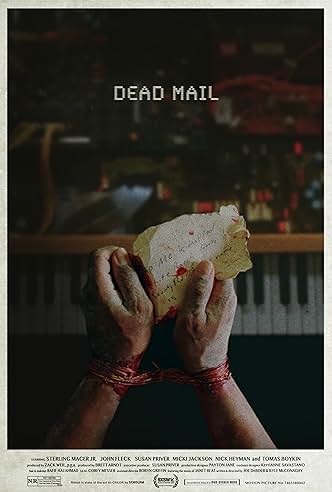

“Dead Mail” (2024) is shot as if it was made in Peoria County, Illinois during the Eighties and based on a true story. Starting from a mailbox to the Glen Avenue Postal Branch and the branch’s investigator, it follows the journey of a scrap of paper covered in blood that acts as ink to transcribe the sender’s cry for help. When the paper ends up in the wrong hands, the film backtracks to reveal how that was possible. Then the final act is about restoration. Willing to risk their lives, government workers go above and beyond to care about their work, their coworkers and strangers in this timely heroic tale.
The first two men who appear on screen are a mystery. Trent Whittington (John Fleck) is keeping Joshua “Josh” Ivey (Sterling Macer Jr.) captive in his home, but Trent gets out long enough to mail that blood-stained scrap. Two women, the clever and insightful Ann Lankford (Micki Jackson) and the sweet but dim Bethesda “Bess Greer (Suan Priver), sort through the dead letters, a term for mail that does not have sufficient postage or information to get to its destination or return to sender. When they find something valuable, they give it to the office hero, Jasper Lawrence (Tomas Boykin), who has a knack for investigating and has a secret weapon, Renée Ogaard (Nick Heyman), a Norwegian spy who has a cover identity as an eyeglass storeowner. “Dead Mail” never reveals how Jasper and Renée developed their professional relationship, but considering that Ann pegs Jasper for being solitary, and he does not correct her, it is an intriguing mystery. Jasper uses work as a social outlet in brief intervals, and by-the-books Brooks (Sean Heyman) enforces the time limit to ensure the security of the office. They each play an important role to solve the mystery and stop a disturbed and dangerous man.
“Dead Mail” keeps Trent blurred in the first act, which is roughly twenty minutes out of one hour forty-six minute runtime. The second act may be baffling if you are unfamiliar with synthesizers and music, but if it is too frustrating, pause and watch “Resynator” (2024) for more context. It may be the slowest act that loses a little momentum. Some incisive trimming could still retain Trent and Josh’s back story. It continues the theme that Jasper introduces in his off hours, where it is revealed that his life outside of work indicates that he exists in the margins and “failed at something.” Trent’s failures are alluded to but are more primal and inscrutable to Trent than he may realize. Josh has a dream to make a synthesizer that sounds like real instruments and work with the big guns in Japan, but Trent financially partners with him, and the extensive, homemade sound system in Trent’s odd home is the only clue why Trent chooses synthesizers and Josh among all the merchants hawking their wares at convention center’s market. Initially their partnership seems like the serendipitous meeting of people with the same rare interest, but Trent starts acting weird enough that even the workaholic, focused Josh starts to see the red flags but fails to act on them before Trent kidnaps him.
The final act of “Dead Mail” involves the postal employees trying to solve a murder mystery because the assigned detective will not do it and has come to conclusions that disparage one of their own. This section is the most conventional portion of the film, but anyone familiar with the law or history will appreciate the focus on postal workers. The United States Postal Service (“USPS”) is a constitutionally authorized independent agency of the executive branch under the President’s authority. On July 26, 1775, the Second Continental Congress, which predates the Constitution, founded USPS’ ancestor, the United States Post Office, so its function even predates the nation. Law enforcement has some origins in slavery in the New World. Other than the description of a house with a “white exterior,” this movie never mentions race, and any actor could play these characters, but the cast has a lot of Black people, which does not feel like a coincidence.
It is unclear whether the filmmakers codirectors and cowriters Joe DeBoer and Kyle McConaghy intended their sophomore movie to address race, but the casting has and shows the effect of slavery’s legacy in today’s world. The post office and its workers are the tenacious, dedicated example of good government, and law enforcement is symbolized as a disembodied, dismissive voice that is ineffective and contemptuous of the people whom they are supposed to serve. Trent is inexplicably wealthy, which is the only asset that he contributes to the world. He is obsessed with Black men, believes that his attention and contribution entitle him (cue Miss Millie’s refrain, “I’ve always been good to you people”) with the right to determine their fate and reacts violently when he cannot control them. He enslaves Josh and is willing to kill anyone who interferes with his control. Trent also has an implied sexual attraction to Black men, which he does not act on. It brings to mind Jeffrey Dahmer, especially the lack of law enforcement’s interest with zero repercussions, but thankfully Trent is not that far gone. It is rare for films to show men holding men captive.
By controlling access to the post office, holding the keys, Brooks is in charge and commands people as if he is their boss. Bess is obedient, unquestioning and the weakest link at the post office with not one good, natural instinct. She accepts the police’s story, never disobeys Brooks and fangirls over Jasper, which puts him unintentionally in danger. Ann questions authority, and Jasper treats her as an intellectual equal. Later, the narrative reveals that she is his protégé in spirit. Jasper and Ann are the ones who make government work, and Josh has the brain power to make it in the private sector if he did not live in the US, but they are punished, not rewarded, for their efforts. This system incentivizes submission, dullness and demented mindsets and marginalizes proactive innovators. All these characters’ failures could be systematic, but they attribute it to individual failings then never recover. An unjust system victimizes all, even the relatively privileged.
“Dead Mail” is visually solid. The claustrophobic shots, the grain of the film, the choice in camera angles, and the constant shifting of POV shots that puts the viewer in each character’s shoes makes the movie feel dynamic even when it unfolds in a handful of interior spaces. Like “September 5” (2025), early technology is treated as innovative and awe-inspiring as it would have felt to the people of that time, around the corner from the world wide web. Unlike “Gazer” (2025), DeBoer and McConaghy’s film looks good and has an interesting story.
“Dead Mail” may feature too many oddball characters and spend too much time in their esoteric interests to appeal to everyone, but it is a strong, unique tale that makes a strong impression. While a second viewing is unnecessary, it may be satisfying to retrace its steps to see how everything fits together. Everyone did an outstanding job. What an inventive way to take a boring bureaucratic division’s name then transmogrify it to become literal and reach every corner.