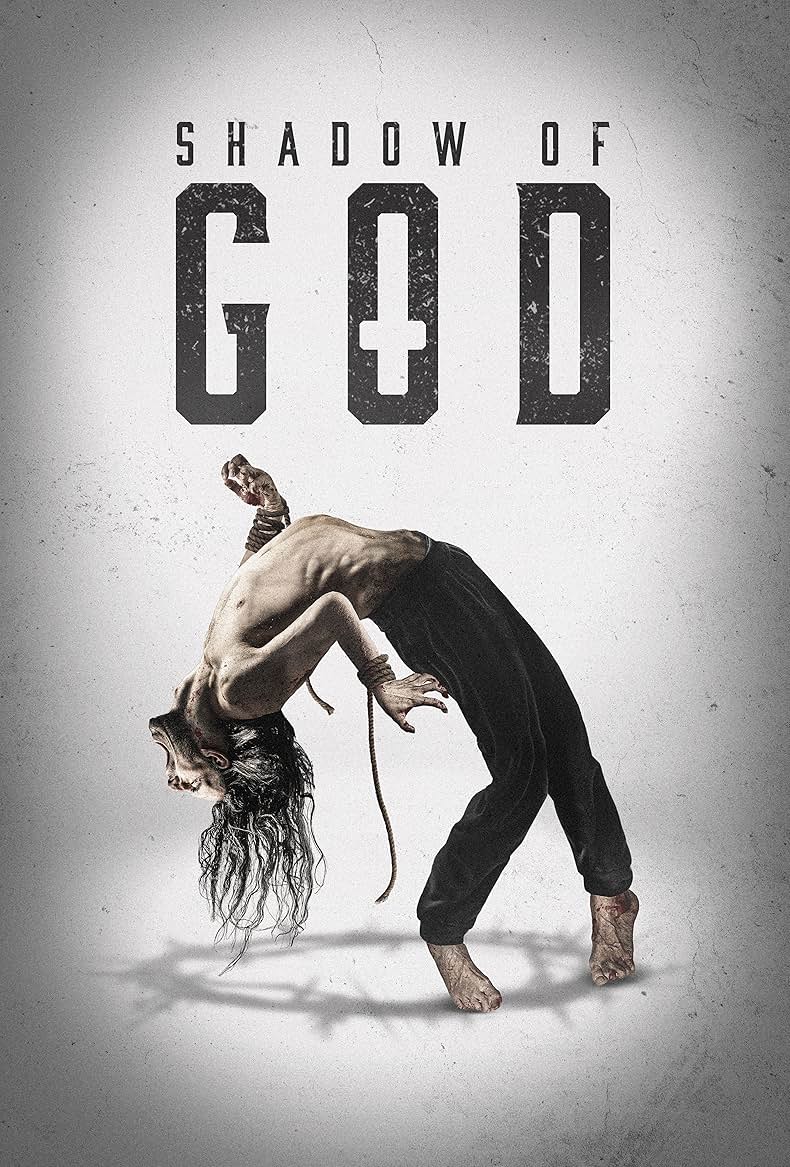

If you are looking for a blasphemous film, Shudder’s latest film, “Shadow of God” (2025) is the right movie for you. Exorcists are turning up dead, and Priest Mason “Mace” Harper (Mark O’Brien) barely survives an encounter with one homicidal possessed person in Guadalajara, Mexico. He returns to his hometown in Southern Alberta, Canada to visit his childhood friend and first/last love interest, Tanis Green (Jacqueline Byers), a psychiatrist who does not share his faith since they survived an abusive childhood as members of a cult, the Congregation of the New Rapture. When he sees his father, Angus (Shaun Johnston), walking around town, Mace is disturbed because his father has been dead since he left the cult as a teen. How could a man get resurrected?
Mace as the chain smoking and hard drinking, world weary priest is less shocking in a world where Constantine exists. O’Brien, who appeared in one of the best movies of the year, “Seven Veils” (2025), resembles Joel McHale so it takes some time to adjust to the fact that he is playing the role as serious as a heart attack, as he should. Tanis seems like a promising character but understandably gets the short end of the stick in favor of Mace. She could have been cut from the entire storyline, and it would have been fine. She gets one good lick in before she becomes a glorified damsel in distress. Better to not have anyone than a vet who does not know how to brandish a weapon even if you are severely wounded and brandishing it against a supernatural figure.
The real story is the abusive father and estranged son theme. Angus seems more remorseful about how he treated his son than Mace feels horrified at the prospect of having to care for his tormenter. O’Brien may have made the correct acting choices considering that he is a priest, but he is way too chill about suddenly functioning as a caretaker for the man who abused him. A flashback answers why he is not fuilled with rage and open to this experience, but it should have been shown a little earlier.
Johnston has a harder job than most. He plays a couple of roles, the penitent father and the possessed man. Some lines should have been punctuated harder such as the father apologizing but stating that it was not his fault. With kids going no contact with their parents, this dialogue should have been more triggering so possession could act as a metaphor for a harmful parent then challenge the idea that he was blameless. After all, Angus chose to have strange symbols carved on his body, preach to a congregation and allow his son to get nailed to a pulpit then whipped. Just because he did not agree to all the terms and conditions does not exonerate him, but “Shadow of God” is just happy that he is not rooting for the end of the world.
The villains are the usual old school, two dimensional, psychotic bad guys who are ushering in the end times. Grand Cleric Beau (Adrian Hough) and his congregants: some women who are the equivalent of Manson girls, maniacally smiling henchmen brandishing shotguns and various plainclothes denizens who are secret members. Anyone who watches movies will see the secret cult members coming from a mile away. Even Lucifer (Josh Cruddas) makes a few pivotal appearances. “Shadow of God” will make more sense with repeat viewings because some images flash so quickly on screen that they are almost subliminal, but they are supposed to represent a dimension where Lucifer communicates with mortals—think red Ginger Ale. It is less ridiculous than it sounds, and a better scene is an upside-down world where objects that appear black in our dimension transform into white in the other. It is a cool oneiric device that gets used judiciously and sets up a double bind predicament for Mace to navigate like a tight rope.
The mythology in “Shadow of God” is seamless. It borrows a little from the Old Testament, possession films, alien invasion movies and poltergeist features. It takes concepts like the rapture, the end of the world, Lucifer, the Second Coming, and turn it on its head. For those looking for a story more faithful to the Bible, the lack of Jesus will be aggravating, but as a Jesus follower, I think that it was a smart move because then it gives plausible deniability to writer Tim Cairo if he must defend himself from angry mobs. It is long overdue for a fringe Protestant cult to face off against Catholic clerics, and while no one wins, Catholics come out ahead, which is going to have a lot of people big mad, especially since some fundamentalists believe that Catholics are not Christians. No one is going to leave this movie without wanting to speak to the manager if they do not have a sense of humor or expect movies to precisely mirror their faith.
“Shadow of God” shares one trait with a Christopher Nolan film: the dialogue can be indiscernible, and it is crucial to understanding the plot. If closed captions are available, turn them on at the beginning or hover your finger over the rewind and play button. It was initially refreshing that Mace was sharing the strange phenomenon with his friend, instead of not giving her notice, so she would be on guard, but she quickly abandons the clear communication. So much for upending a trope.
It is hard to make a fresh possession film. While “Shadow of God” has modest production values, and the acting is solid, but will not be setting the world on fire, I will put on my cape to defend it from naysayers. It is a nice twist that “The Front Room” (2024) and “MaXXXine” (2024) teased but pulled punches instead of exploring the implications to their furthest corner, which is surprising since technically “Supernatural” already navigated this territory while skirting offending people of faith in the real world. I wish that the plot twist was not revealed in the trailer or promotional material because it could have surprised its audience, but I saw it coming without seeing the trailer.
S
P
O
I
L
E
R
God possessed Angus. First sign: he could not die and still has his wounds. Second sign: when Angus spoke as a possessed person, he kept using the phrase, “I Am,” which is another word for Yahweh. Third sign: he got stronger as the exorcist ritual continued. Fourth sign: light and heat signifies God’s presence: the burning bush, tongues of fire, Mount Sinai’s smoke, lightning, fire and thunder. The fifth sign: human beings are unable to stand in God’s presence or see the face of God unless authorized. Extra points for bringing back “Indiana Jones and the Temple of Doom” (1984) for this one, and for fun, I’m going to assume it is a cult with Nazi allegiances despite the convenience store clerk being a man of color.
“The Vatican Tapes” (2015) felt like another paint by numbers possession film until the denouement, but “Shadow of God” had me excited from soup to nuts as I realized that the filmmakers were willing to fully explore its concept without being too preoccupied with how it would be received. I love the idea of God as a force that cannot be comprehended or contained, not the safe idea that gets taught in Sunday School. Even though this entity is abusive, anyone who has felt God’s power knows, including C.S. Lewis, that He is not tame or safe. While the special effects are shaky, it still works. God’s face as the unknowable, vast cosmos resonated though it looks a bit goofy. This film explores the concept raised in “Glorious” (2022).
The most provocative concepts are parallelling the idea of God as an abusive father and the rebellious son priest as Lucifer. Considering the stories of Isaac and Abraham and Jesus and God, among many others, I do not have a problem with it, but it does explain why “Shadow of God” goes above and beyond to have Mace kill Lucifer before he quits his job. Normally I roll my eyes at storylines that completely reject the concept of the supernatural and say that the real faith should be in humanity (eyeroll) but the resolution did not feel pat. It was rough and hard won. No one gets along—not the cult survivors, the cult, the families, friends, God, etc. It feels realistic that everyone gets on everyone else’s nerves, not a humanistic, optimistic note.
The sign of a good movie: if it had more money, it would be better. “Shadow of God” has a solid, well thought out story that could have benefitted from having a bigger budget. It was a brilliant move to mix the quotidian nightmare of Waco with cosmic horror. It may be one of my new favorite possession films, and I’m hard to please in this category of horror, which is overused and rarely breaks new ground. Canadian horror has always been the unexpected dark horse in cinema despite producing the legend David Cronenberg, “Black Christmas” (1974) and many others.